The addresses were always close together. The distances between them tell you something about a life.
A Small World With Precise Edges
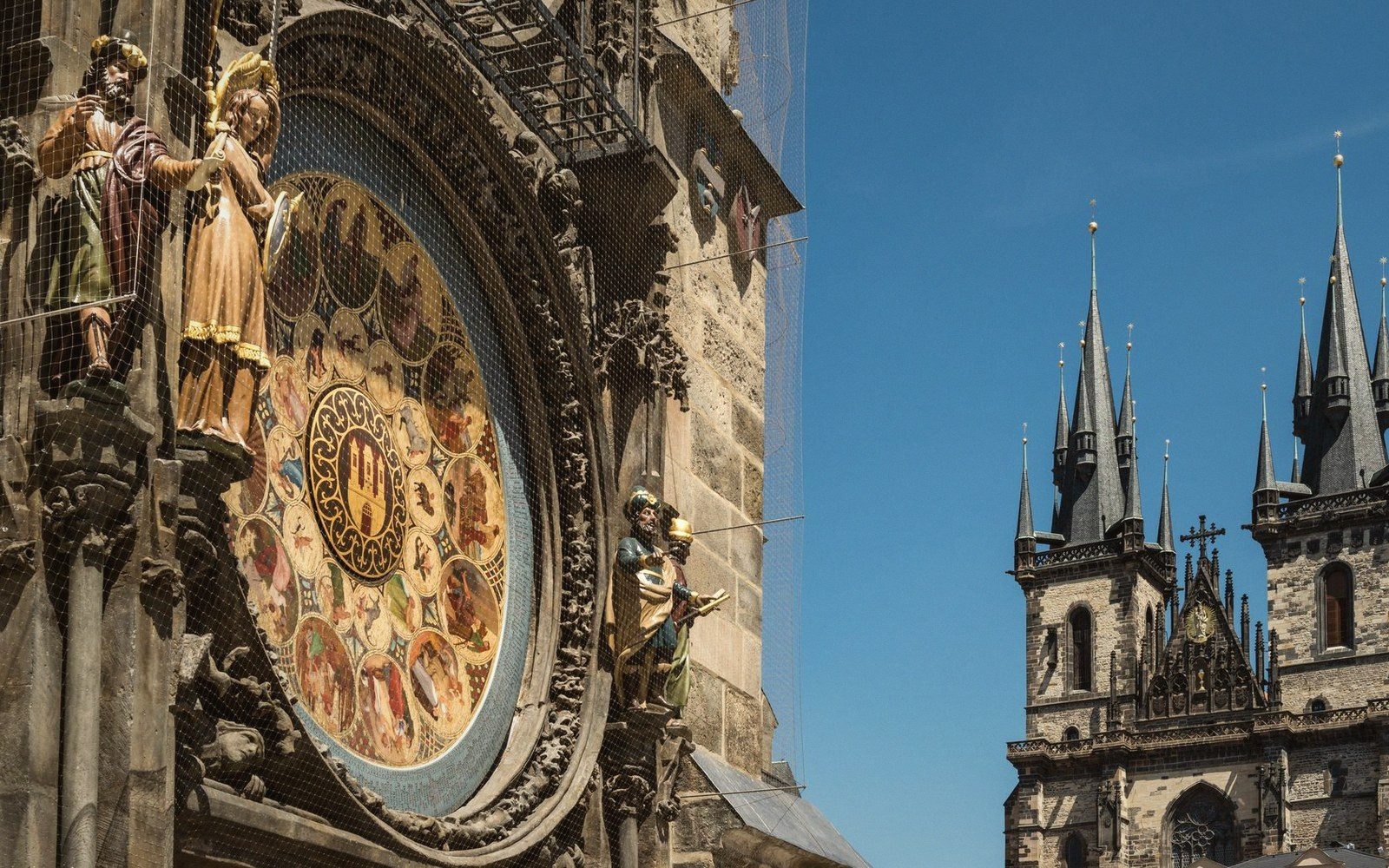
Franz Kafka was born in 1883 in a house that no longer stands, on the corner of Maiselgasse and Kaprova, a few steps from the Old Town Square in Prague's first district. Over the following decades, his family moved repeatedly — to Wenceslas Square, to the Zeltnergasse, back to the Old Town — but the radius stayed remarkably tight. Almost everything essential in Kafka's daily life happened within a kilometre or two of that original corner. The square itself, Staroměstské náměstí, with its Astronomical Clock and its paired towers of the Týn Church, was not a landmark he occasionally visited. It was the centre of gravity he walked around, and sometimes through, nearly every day.
This compression matters more than it might seem. Prague's German-speaking Jewish minority — the community into which Kafka was born, in which he was educated, and from which he never fully departed — occupied a particular social and linguistic position inside the city. German in a Czech city, Jewish in both, this community was numerically small, clustered in certain neighbourhoods, and served by its own institutions: German-language schools, the German Casino, a scattering of cafés and reading rooms where the language and its anxieties could be shared. Kafka's geography was not simply a matter of where apartments were affordable; it was a map of a minority culture's footprint in a city that was also, simultaneously, Czech, Habsburg, and rapidly modernising.
The neighbourhood that had been the Jewish Quarter — Josefov — was undergoing radical change throughout Kafka's childhood and early adulthood. A programme of slum clearance that began in the 1890s demolished most of the old streets, replacing them with wide boulevards in a style that self-consciously imitated Haussmann's Paris. Kafka watched this erasure as a young man. In a letter, he once described Prague's beauty as inseparable from its sadness, though no exact wording is quoted here.. What is documented is that the streets he had known as a child were, by the time he was writing seriously, already gone or transformed — a fact that sharpens the retrospective quality his fiction sometimes carries.
From Apartment to Office to Café
The family apartment in the Zeltnergasse — now Celetná ulice — sat directly on the route between the Old Town Square and the Powder Tower, one of Prague's medieval gates. It was a major artery, commercially busy, and the Kafka household occupied different floors of buildings along it at various points. Hermann Kafka's shop, which sold fancy goods and haberdashery, was on the ground floor of one such building. Franz Kafka grew up, then, not above a quiet courtyard but above a retail operation, with all the noise and obligation that implied. His later writings about paternal authority, commercial pressure, and the difficulty of claiming private space draw on something lived rather than imagined.
The insurance office where Kafka spent the working portion of his days was the Workmen's Accident Insurance Institute for the Kingdom of Bohemia, headquartered on the Pořič, a short walk north from the Old Town. He joined the Institute in 1908 and remained there, rising through its bureaucratic grades despite persistent attempts to leave, until illness forced his retirement in 1922. What Kafka actually did there — and he did real work, writing legally careful reports on accident prevention and industrial risk — is often elided in favour of a simpler image: the tormented writer trapped in a grey office. The reality was less dramatic and perhaps more interesting. He was competent, even respected. He earned a pension. The office was not a cage so much as a second life running in parallel with the first.
The walk from the Old Town Square to the Pořič took perhaps twenty minutes on foot, passing through streets that today are central European tourist landscape but in Kafka's time were an ordinary commercial city still part of the Austro-Hungarian empire, whose end was approaching. He made that walk, or variations of it, for the better part of fourteen years.
The evenings, when they were not given over to writing in the apartment his family shared — an arrangement that frustrated him repeatedly and which the diaries record with flat precision — sometimes ended in the cafés and establishments where Prague's German-speaking literary circle gathered. The Café Arcos, on the Na Příkopě, was one such place. The Café Savoy, further into the Old Town, was another, and it was there that Kafka encountered the Yiddish theatre company whose performances in 1911 and 1912 moved him deeply and opened a sustained engagement with Eastern European Jewish culture that his diaries document with unusual warmth.
Max Brod, his closest friend and the man who would refuse to burn the manuscripts, lived nearby. Brod's own apartment was within the same compact territory. So was the Café Louvre on the Národní třída, where the writers who formed the Prague Circle — Brod, Franz Werfel, Oskar Baum, Felix Weltsch, and at the margins always Kafka — would meet, argue, and read work aloud. None of these venues required Kafka to leave what was, in effect, a single walkable neighbourhood. The intensity of that circle — its arguments about Zionism, about the German language, about the purpose of literature in a city that seemed to belong to everybody and nobody — took place in rooms he could reach in minutes.
The Square Itself
The Old Town Square deserves a moment of direct attention. Kafka's relationship to it was the relationship of a lifelong local: familiarity without sentimentality, and perhaps a particular alertness to what the square performed rather than was. It had been, for centuries, the site of public executions — most famously, in 1621, the execution of twenty-seven leaders of the Bohemian Estates' rebellion against Habsburg rule. By Kafka's time, the square was a public gathering place, a transit point, and the location of the Jan Hus memorial, unveiled in 1915, which became a contested symbol of Czech national identity at the precise moment the empire was beginning to crack.
Kafka's diaries from the mid-1910s show him alert to the city's political temperature without being reducible to a political writer. He noticed things. The square was a place where the various populations of Prague occupied the same physical space while occupying quite different social ones — Czech and German, Jewish and Christian, Habsburg subject and nascent nationalist. If his fiction sometimes has the quality of a man watching a mechanism operate whose rules are visible but whose purpose remains opaque, the city he walked through every day may have trained that gaze.
There is also the matter of scale. The Old Town Square is genuinely large — the Týn Church's towers visible from considerable distance, the Astronomical Clock drawing crowds on the hour even then. For a writer whose fiction tends to work in narrow corridors, low ceilings, and rooms whose dimensions are uncertain, the square's openness reads almost as counter-evidence, a spaciousness his imagination persistently refused. The burrow is not Old Town Square. The geography of the fiction runs underground and inward, even as the man who wrote it walked, day after day, across open cobblestones.
The house at the corner where he was born was demolished in the clearances. The apartment buildings on Celetná still stand, repurposed. The insurance office building on the Pořič survives and carries a plaque. The café sites have changed hands, been renamed, been converted. The square itself is, of course, there — heavily touristed now, the astronomical mechanism still cycling through its figures on the hour, the towers of the Týn Church still dominating the eastern end. Visitors come for the image they already have: medieval Prague, Gothic towers, the city of Meyrink's Golem. Kafka walked through something denser and more particular: a city in the middle of becoming something else, carrying the weight of what it had been, uncertain about who, in the end, it belonged to.
He never left. That, finally, is the geographical fact that keeps returning. Despite plans, despite wishes, despite the years of letters to Felice Bauer in Berlin and Milena Jesenská in Vienna, despite a brief period in Berlin near the end of his life, the city held him. His repeated plans to leave — and the gap between plan and departure — are well documented. The streets he knew stayed the streets he knew. The walk from the family apartment to the Old Town Square, from the Old Town Square to the insurance office, from the insurance office to whatever café the evening required: these were the coordinates of a life conducted, against all ambivalence, in one place.
End of article · Prague