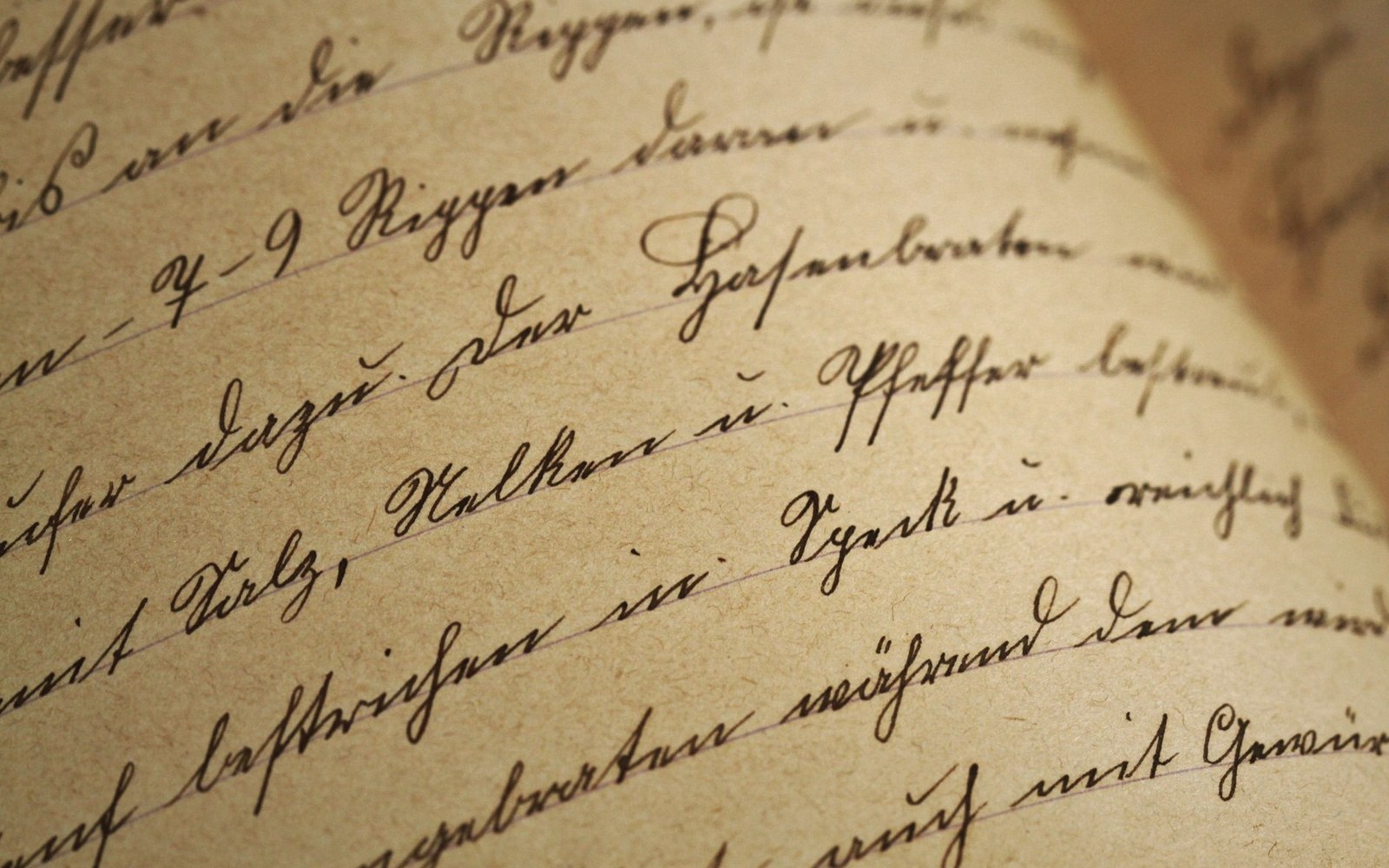
Reading Der Proceß as Kafka left it — disordered, unordered, and more honest for it.
The Manuscript Kafka Put in a Drawer
Franz Kafka wrote the bulk of Der Proceß — published in English as The Trial — in a sustained burst of work between August 1914 and January 1915, then set it aside without ordering the chapters, without completing the final revision, and without any recorded instruction that it should be published. When Max Brod retrieved the manuscript after Kafka's death in June 1924, he found a folder of chapters written on loose gatherings, without consistent numbering, and with several chapters left unfinished. The first chapter and the last — Josef K.'s arrest and Josef K.'s execution — were complete and clearly belonged where they stood. Everything between them was not arranged.
This is not a minor textual detail. It is the central fact about the novel, and most readers of the standard English translations have never been told it, or have been told it only in a footnote where it can be conveniently set aside.
Brod made an editorial decision that shaped how the novel was read for decades: he placed the unfinished and fragmentary chapters at the end, after what he judged to be the complete ones, and he assigned a sequence to the middle chapters based partly on internal evidence and partly on conversations he recalled having with Kafka. The 1925 German first edition presented the result as a continuous text, and Willa and Edwin Muir's English translation of 1937 — which introduced Kafka to most English readers — followed Brod's ordering. The impression left was of a novel that felt formally strange but was structurally settled: a beginning, a series of increasingly desperate episodes, an ending. Readers experienced the disorder as atmosphere rather than as fact.
What the Manuscripts Actually Show
The physical manuscript tells a different story. Chapters that Brod placed in sequence were not stacked in any reliable order; the incomplete chapters — among them the fragments conventionally called "Journey to His Mother" and "To Elsa" — were not residue from an abandoned subplot but integral to the book's unresolved directions. Later scholarly work, culminating in the critical edition prepared by Malcolm Pasley and published by S. Fischer Verlag in 1990 as part of the Kritische Ausgabe (Critical Edition), produced for the first time a text that presented the middle chapters in their manuscript state without imposing Brod's sequence. The Pasley edition does not pretend to know what Kafka intended, because the evidence for a single intended order does not exist.
What it offers instead is something more faithful to the actual condition of the text: a first chapter, a last chapter, the middle chapters in the order the manuscript physically presents them, and the unfinished fragments clearly identified as such. Readers who come to the novel through this edition — or through translations based on it, including Breon Mitchell's 1998 English version — encounter a book that does not settle into a reassuring arc. The middle, which is where Josef K. lives, stays genuinely uncertain.
This matters because the novel is about a process — a legal process, an existential process — that is never explained, never fully seen, and never completed. Josef K. is arrested for a crime that is never named, tried in courts that he can never locate with certainty, and executed by men he cannot resist. The story's logic is that of an institution that generates its own total authority from nothing visible. To receive that story in a text whose own internal order has been quietly settled for you, whose fragments have been tidied to the back, is to receive it with one of its most disturbing properties neutralized.
The Disorder Is Not a Problem to Solve
The temptation, for editors and for readers, is to treat the incompleteness as a wound to be dressed. Find the right chapter order, restore the missing sections, determine what Kafka meant, and the novel can be presented whole. But this project misunderstands what incompleteness does here. Unlike a manuscript interrupted by death midway through — which is genuinely a different kind of loss — Der Proceß has a completed opening and a completed close. What it lacks is not an ending but a settled middle: a stable account of how Josef K. moved through the machinery that was consuming him. That the account is not stable, that the chapters refuse to lock into a single authoritative sequence, mirrors with uncomfortable precision what the novel itself describes. Josef K. can never get a fixed account of his case either. The court's procedures are not recorded in any document he is permitted to read.
To read the novel in the knowledge of its textual condition is to experience this parallel. You are, like Josef K., working from incomplete information. You are, like him, inclined to trust the sequence you have been handed. You may notice, as he does, that the sequence sometimes fails to cohere. The question of whether there is a correct order underlying the apparent disorder — a true structure that would make everything legible — is Josef K.'s question, and it is unanswerable for him in the same way it is unanswerable in the manuscript.
None of this requires mystifying the incompleteness or treating it as though Kafka somehow planned the disorder. He did not plan it; he left the manuscript in a drawer. But the relationship between the novel's form and its subject is not incidental, and editors who smooth it away in the name of readability are making a stronger editorial decision than they sometimes acknowledge — one that resolves, before the reader has even begun, the very uncertainty the book is built on.
The responsible approach — and the more interesting one — is to read Der Proceß knowing that the chapter you are in may not be where any final intention would have placed it, that the incomplete fragments are part of the book's actual substance, and that the clean continuity of most printed editions is a gift from an editor rather than from the author. This does not destabilize the novel's power. Josef K.'s final walk, "like a dog," through Prague's outskirts remains one of the most devastating endings in twentieth-century fiction. But it lands differently when you have not been falsely reassured that everything before it was in order, because in Der Proceß, nothing is.
End of article · The Work