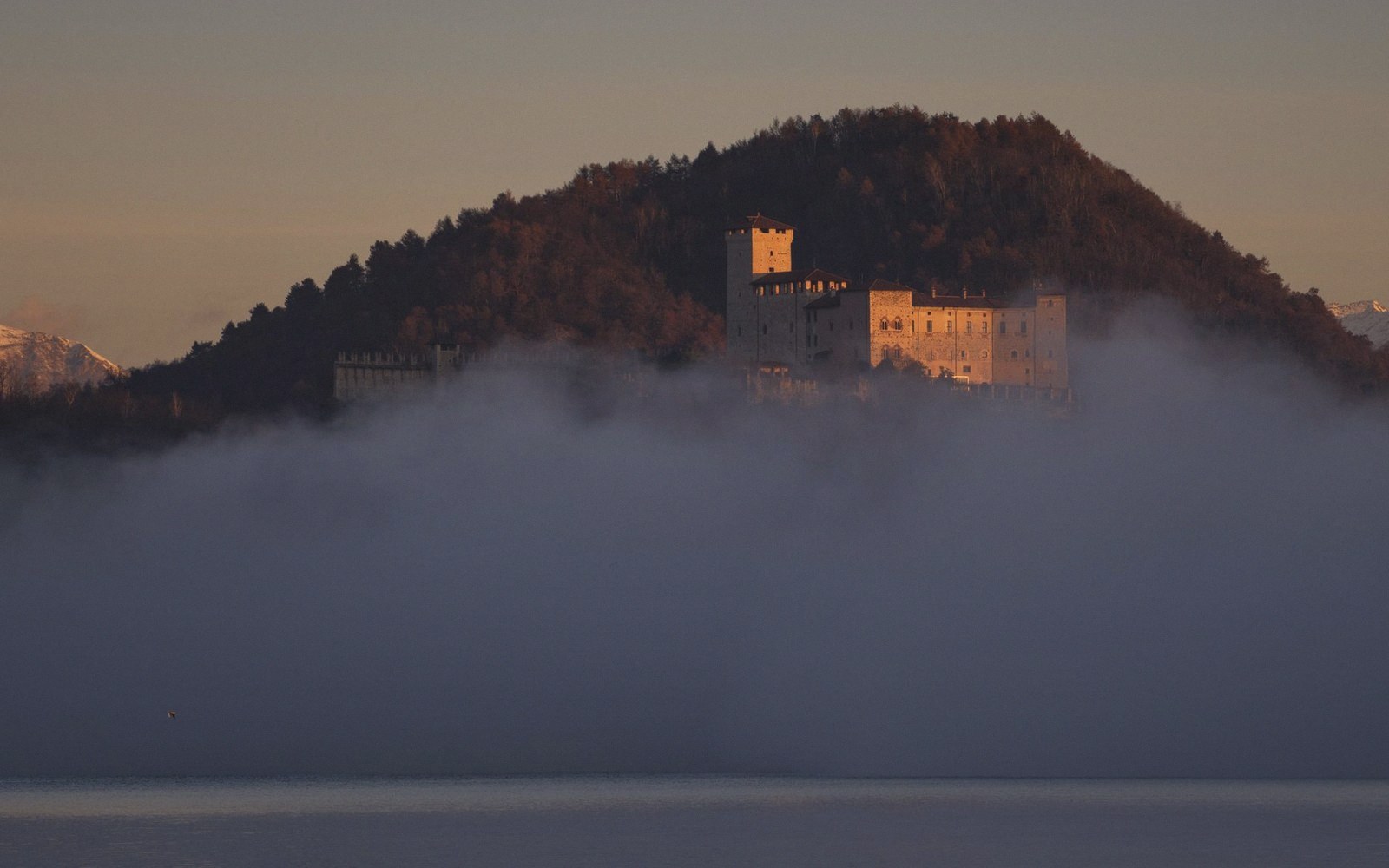
The village at the foot of the castle is not a place of refusal. It is a place of endless referral — and that distinction is everything.
A Bridge in the Fog
Das Schloss — The Castle — opens with K. arriving on a wooden bridge, looking up at what should be his destination. The hill above him carries a castle, but Kafka describes it in terms that immediately erode certainty: the main tower appears uncertain in the fog, with something that might be battlements, though it may simply be a trick of light. The castle is present in the opening paragraphs only as a visual dissolve. This is not atmosphere for its own sake. It is a structural announcement.
K. has been summoned, or claims he has been summoned, as a land surveyor. The Count Westwest — whose name itself doubles back on itself, heading nowhere — presumably controls the castle. But the novel's first real action is not K. approaching the castle; it is K. being told he cannot stay in the village without permission. The castle, in other words, is already operating as an absence that produces bureaucratic pressure below it.
What makes this opening movement so precise is that no door is ever slammed. The young man, Schwarzer, who first addresses K. is not hostile; he is simply pointing out a reality. The landlord who takes K. in does so provisionally. The telephone call placed on K.'s behalf yields not a refusal but a noise from the receiver — described as a hum of voices, a kind of collective murmur — that might be the castle or might be something else entirely. The first answer that comes through is that no land surveyor is known. A second call then reverses it: K. is indeed expected, as a land surveyor. Both messages are treated, in the village, as equally official.
The System Is the Deferral
This is where Kafka's construction becomes almost architectural in its logic. The village does not obstruct K. through malice or even through rules clearly stated. It defers him. Every contact with the castle's authority passes through an intermediary — Schwarzer, then the landlord, then Barnabas the messenger, then Olga's account of how messengers work — and each intermediary introduces a new layer of uncertainty about whether the layer above them is even aware of the transaction below.
Klamm, the castle official who becomes K.'s fixed object of pursuit, is never reliably described. Different characters who claim to have seen him offer incompatible physical descriptions. The landlady at the Herrenhof insists that K.'s belief that he knows what Klamm looks like is simply incorrect — not because she has better information, but because the question of what Klamm looks like may be unanswerable in principle. He looks different descending stairs than climbing them. He looks different in the village than in the castle. This is not mystification. Kafka is building a consistent epistemology in which the authority-bearing figure exists only in his effects on those below him.
K. keeps moving, keeps pressing, keeps attempting to reach a definitive encounter. The novel's comedy — and it is genuinely comic — lies in the gap between his methodical persistence and the utter groundlessness of the terrain. He acquires two assistants he did not ask for and cannot dismiss. He becomes entangled with Frieda, Klamm's former mistress, in a relationship that promises some lateral approach to power and delivers instead another orbit around the same hollow centre.
The Unfinished Novel and the Finished Idea
Kafka left Das Schloss incomplete at his death in June 1924. Max Brod, who prepared the first published edition in 1926, added a chapter break and provided — based on Kafka's reported words — a projected ending in which K. receives, while dying, a conditional permission to stay in the village. This ending was never written.
The scholarly and readerly consensus, earned over decades, is that the novel's unfinished state does not feel like amputation. It feels like the form matching its content. A novel about a man who cannot reach his destination does not need to reach one. The structural logic — each step generates not progress but a new intermediary, a new deferral, a new partial message from an authority that never directly speaks — implies an infinite regress that no final chapter could honestly resolve. The castle is not withholding something it possesses. It is a system in which the promise of resolution is itself the mechanism of control.
When K. looks up at the hill early in the novel and sees the castle slightly dissolving in fog, Kafka has already told the reader everything essential. The castle does not lock its gates. It simply remains, always, slightly out of focus.
End of article · The Work